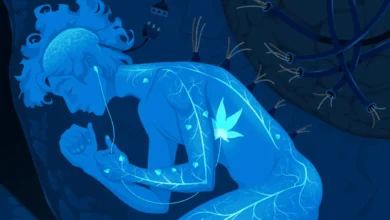

When a man was diagnosed with Stage IV colorectal cancer, his daughter faced a difficult truth: love could not save him.
She recalled standing with her father after his diagnosis. He quietly asked if this was what would kill him. She responded by trying to bargain, telling him it would not take him if he did not want it to. Even as she said the words, she knew they were not true. She realized she was not talking to him. She was talking to fear and to the impossible reality that her father might die.
For most of her life, her father had been larger than life. He was stubborn, funny, and independent. He treated rules as suggestions and authority as a challenge. He was also the person who made her feel safe. Suddenly, he was looking to her for reassurance. That moment marked a reversal of roles that many adult children face but few are prepared for. The person who once carried you begins to lean on you. The person who once had answers begins asking questions.
People often think grief begins when someone dies. Her experience taught her otherwise. Grief sometimes begins the moment you realize they will die.
As the illness progressed, each family member found a different way to cope. One sister organized appointments and schedules. Another flew across the country and sneaked avocado into his soup because of nutritional benefits. There were green smoothies, supplements, treatment plans, and research articles. Her mother had a different view. She said to let him eat what he wanted because he was a dying man.
At the time, everyone seemed to speak different languages. Looking back, she realized they were all doing the same thing. They were trying to create certainty where none existed. Loss exposes how uncomfortable people are with uncertainty. Some manage. Some research. Some fix. Some avoid. Some become angry. Most cycle through all of them.
She was not immune. She expressed it differently. Instead of trying to save him, she became obsessed with making things easier. She wanted to hire help, reduce his stress, and simplify his life. She was searching for something useful to do because usefulness felt safer than helplessness.
One of the most important lessons she learned was that action and control are not the same thing. Action can be helpful. Control is often an illusion. The more she tried to manage the situation emotionally, the more exhausted she became. The more she accepted what was happening, the more present she could be. That sounds simple. It was not.
Acceptance is often misunderstood as giving up. For her, acceptance meant acknowledging reality while continuing to love him fully. It meant understanding she could not change the outcome, but she could influence the experience. She could choose how she showed up.
One of her favorite memories happened during a hospital visit. He was getting a port installed for treatment. The campus was strictly non-smoking. Her father wanted a cigarette. She told him it was not allowed. Then she left to get the car. When she pulled up, he was sitting in the passenger seat wearing a big grin. He pointed to the ground next to the curb. There was a half-smoked cigarette someone had thrown away. He had rescued it and was proud of himself. She laughed. In that moment, he was not a cancer patient. He was not a diagnosis. He was simply her dad. Stubborn, resourceful, and unapologetically himself.
That memory taught her something she did not fully understand at the time. When people approach the end of life, others often focus so much on preserving them that they stop seeing them. They see symptoms, appointments, medications, and decline. They forget the person still exists underneath. The greatest gift someone can offer is not always solutions. Sometimes it is attention and remembering who they are.
As the months passed, unexpected memories surfaced. She would be standing in her kitchen and suddenly find herself transported back to childhood. She could see them in the driveway in Sonoma, California. She could hear his laughter. She could feel the wobble of her bike as he taught her how to ride. The memories were not dramatic. They were ordinary. That made them more powerful. She now thinks her mind was preserving him. Not the version that was sick. The version that was alive and had shaped her.
Toward the end, people began unraveling. Patience disappeared. Arguments appeared out of nowhere. Small disagreements became major conflicts. Everyone seemed emotionally raw. At the time, it felt chaotic. She now understands it differently. When people feel powerless, emotions look for somewhere to go. Fear often disguises itself as frustration. Sadness often masquerades as anger. Grief rarely arrives in a neat, recognizable form. Sometimes it arrives wearing different clothes.
She wishes more people understood there is no perfect way to navigate these experiences. There is only awareness. The more aware people become of what they are actually feeling, the less likely they are to project it onto everyone around them.
For anyone facing a difficult loss or a life transition that feels bigger than their ability to manage it, she offers a few lessons. Stop expecting certainty. The need for certainty creates additional suffering because life rarely offers it. Pay attention to how you are trying to gain control. Are you fixing, researching, avoiding, or fighting? Understanding coping strategies does not eliminate them, but it helps you use them more consciously. Do not wait for perfect moments. The meaningful moments are usually ordinary. A conversation in a parking lot, a shared meal, a ridiculous joke, or a half-smoked cigarette discovered on the ground are often the moments that stay.
Most importantly, being present is enough. You do not have to solve every problem. You do not have to carry every emotion. You do not have to make an impossible situation feel acceptable. Sometimes the bravest thing you can do is stay. Stay for the conversation. Stay for the memory. Stay for the laughter. Stay for the heartbreak. Stay for the person.
Her father eventually died. When she thinks about that season of her life now, what remains is not the fear. It is not the diagnosis. It is not even the loss itself. What remains is his smile, his personality, his stubbornness, and the moments when he was unmistakably himself. That is when she finally understood what anticipatory grief had been trying to teach her. Love is not measured by the ability to save people. It is measured by the willingness to be with them, fully and honestly, even when you cannot save them.